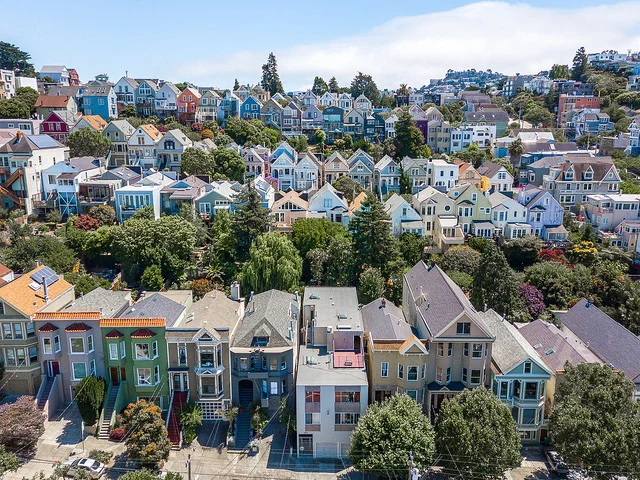
Walkability is one of the top requests I hear from buyers, which is exactly why I think everyone should have the Castro / Eureka Valley on their list. This is San Francisco’s most historic LGBTQ neighborhood and one of the most genuinely walkable areas in the entire city, with flat blocks, a commercial strip that covers everything from groceries to gyms to boutique shopping, and immediate access to Dolores Park, Noe Valley, Hayes Valley, and the Mission. In Eureka Valley, the MLS name for what everyone in San Francisco calls the Castro, 55 single-family homes sold last year at a median price of $3.1 million, and 77 condos sold with average three-bedroom units coming in at $1.6 million.
The Castro earns its reputation as one of San Francisco’s most walkable neighborhoods because it offers two full commercial corridors, Castro Street and 18th Street, that cover virtually every daily need in a flat, easy-to-navigate stretch.
Walking through the neighborhood, I’m always struck by how complete it feels. On Castro Street alone you have a hardware store that’s been an institution since the 1930s, multiple pizza shops, a famous cookie shop, boutique men’s clothing stores, a French seafood brasserie with a back patio, a Phil’s Coffee, a Walgreens , a Mollie Stone’s grocery store on 18th, and I genuinely wondered about this while writing this — possibly more gyms per capita than any neighborhood in San Francisco. On this one stretch: Soul Cycle, a Pilates studio, Barry’s, and Fitness 24. That’s four. And I love a neighborhood where you don’t have to get in a car to stay healthy, run errands, get a massage at Wella, or have a great dinner.
What makes it especially strong for buyers is that the walkability isn’t limited to one strip. Walk a few blocks south and you’re into the restaurants and shops along Church Street. Go toward Noe Valley and you hit another full walkable corridor. The neighborhood sits at the center of several of San Francisco’s best areas, which means you’re not just buying access to the Castro, you’re buying access to everything around it.
The Castro is San Francisco’s most historic LGBTQ neighborhood and one of the first gay neighborhoods in the United States, and it carries that identity with genuine pride, flags flying on every block, full windows with nothing to hide, and a community that I think truly welcomes everybody.
One of the things I love most about San Francisco as a city is how inclusive it is, and the Castro is where that spirit is most visible. You don’t need to live in one box to live in this neighborhood. Every walk of life is welcome, and the neighborhood has that energy. It’s lively, urban, and full of personality. Walking through it, you hear it. It’s not a quiet neighborhood. It’s a neighborhood that’s alive.
The Castro Theater is a very historic venue where I’ve personally seen the Rocky Horror Picture Show (where you can get up and dance) and Frozen with my kids in a sing-along format was closed for two years and is set to reopen. That’s a big deal for the neighborhood. It’s one of the main cultural anchors of the area and everyone I talk to is excited to have it back.
The local resident I spoke with at the hardware store put it well: the neighborhood is finding its voice again. Some of the older businesses have turned over, which has brought in new energy, while the legacy spots that have been there for decades give it roots and a community feel. The result is a neighborhood that feels both historic and alive at the same time.

In Eureka Valley 55 single-family homes sold last year at a median price of $3.1 million, or approximately $1,350 per square foot.
I want to be clear about the MLS naming because it trips up a lot of buyers searching online: if you’re looking for the Castro on a listing map, you need to search Eureka Valley. That covers the flat commercial area most people think of as the Castro, and extends all the way up the hill.
Those median prices, $3.1 million, $1,350 per square foot, closely mirror Noe Valley, where I have a lot of buyers looking at both neighborhoods simultaneously. The difference is that Noe Valley has specific streets and blocks where prices spike significantly above that median. That’s something I can walk you through if you’re comparing the two.
If $3.1 million is out of range, the condo market offers real options. There were 77 condos sold in Eureka Valley last year, and the average three-bedroom, one-bath condo came in at $1.6 million, roughly half the single-family price. There’s a lot of housing stock in the neighborhood, and the period architecture makes even the condos worth looking at seriously.

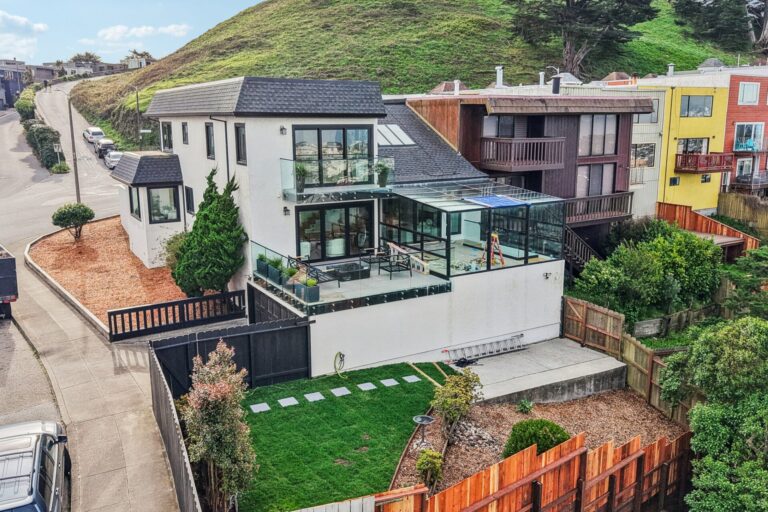
Liberty Hill is the elevated section of Eureka Valley. It stretches up from the commercial corridor toward Liberty Street and Sanchez and it trades the flat easy walkability of the Castro strip for some of the most spectacular city views in San Francisco.
I’ve sold more homes on 21st Street than any other street in the city, so I know this hill well. Up here, the neighborhood gets significantly quieter. Streets like Liberty and Sanchez twist around in ways that mean you’re not getting cut-through traffic unless you live there, you’re not driving through. That privacy, combined with the views, is a major draw.
The views themselves are hard to overstate. Looking north toward the city, and catching the bay in the distance it’s stunning. I’d say the only other location in San Francisco that rivals these views is Clarendon Heights, but Clarendon Heights is a car neighborhood. Liberty Hill, for all its elevation, is still relatively easy to get down to the Castro strip quickly. Getting back up is the workout.
Prices up here reflect the premium. A home that just sold on one of these streets this week came in at close to $2,500 per square foot. It was a small house, and I’d note that price per square foot tends to spike on smaller homes because the denominator is lower, but it was a one-of-a-kind property with a very notable architect, and it received more than 20 offers. San Francisco architecture sometimes produces something that just steps outside the norm, and when that happens, everybody wants it. This was that house.
For reference on what this section can look like at the high end: a home with a yellow door on this stretch that we did a full video on, which became one of our most popular videos on the channel, sold for approximately $6.3 million about a year and a half ago.


From the Castro, you can walk to Noe Valley, Hayes Valley, the Mission, and the edge of Dolores Park, making it one of the most centrally connected neighborhoods in San Francisco for people who want to move between different areas on foot.
This is the part buyers underestimate until they actually walk the neighborhood with me. Head south and you’re in Noe Valley. Head northwest over the hill and you’re coming down into Nopa, with the park nearby. Head toward Church Street and you hit another full restaurant and cafe strip. Keep going and you reach the Mission. The Castro sits at the intersection of several of San Francisco’s best neighborhoods, which means your daily life isn’t confined to one strip — it expands.
For getting downtown or to the peninsula, the transit options are strong too. The F Market streetcar runs straight downtown (with frequent stops, so it’s not the fastest). The Castro Muni station — right near Soul Cycle on the main strip — has several lines and is the faster option for getting downtown quickly. The 22 bus runs through and will take you to the north side of the city. And for tech workers commuting to the peninsula, there’s a freeway on-ramp just a few blocks from the neighborhood, which I point out to buyers who are worried about that commute.
Dolores Park sits right on the edge of Eureka Valley, one block from the neighborhood, and it’s one of the best urban parks in San Francisco for people of all ages, with basketball courts, tennis courts, iconic city views, and some of the city’s best food and coffee within walking distance.
I think Dolores Park is one of the best parks in the city, full stop. What I love about it is that it works for everyone. Adults, kids, dogs, people who want to sunbathe, and people who want to run — it all happens at once, and somehow the park holds it all. On a Thursday afternoon in the middle of the week, it was packed with people just enjoying a great day.
The food access around the park is exceptional. You can walk to Tartine for pastries, Bi-Rite for drinks and sandwiches, Bi-Rite Creamery for what I’d call some of the best ice cream in the city, and then end your evening at Delfina, which was redone a couple of years ago and is absolutely stunning inside, for a great Italian dinner. I’m genuinely surprised sometimes that food that looks so simple can taste that good.
The city invested significantly in Dolores Park a few years back, renovating the playground and upgrading the facilities. The result is a park that competes with anything in the country for what a dense urban neighborhood park can be.

The Castro and Noe Valley have similar price points. Both medians around $3.1 million for single-family homes but the Castro offers meaningfully more in terms of daily walkability and urban amenities, while Noe Valley delivers more sun.
I work with a lot of buyers who are looking at both neighborhoods simultaneously, so I have a clear sense of what each one offers. Noe Valley is warmer and sunnier, and weather adds approximately 20% to value in San Francisco, so that matters financially as well as practically. Noe Valley also has its own great 24th Street commercial corridor. But it doesn’t have the breadth of daily living options that the Castro does.
Walking through the Castro, you have boutiques, multiple gyms, a hardware store, a grocery store, banks, a pharmacy, massage, and coffee all on a flat stretch. Noe Valley has great restaurants and some shops, but for the full range of daily errands and urban living, the Castro is in a different category.
The other meaningful difference is that Noe Valley has certain streets and blocks where prices spike significantly above the neighborhood median. If you’re budgeting to $3.1 million, assuming that’s what Noe Valley costs, you may find yourself priced out of the specific blocks you want. The Castro’s median is similar, but the distribution of prices tends to be more consistent across the neighborhood.
If you’re deciding between the two and want to walk both neighborhoods with someone who has sold extensively in each, reach out to us. A conversation will save you a lot of time.