The question that prompted this entire analysis was simple: Can you even buy a single-family home in San Francisco for under $2.5 million anymore? I pulled every citywide sale for three-bedroom homes that closed in this price band, cross-referenced the competition data by neighborhood, and the numbers were striking. There are eight neighborhoods where this budget actually works, and the difference between choosing the right one and the wrong one is the difference between winning and losing offers for months. Here is what I found.
Yes, but only in eight specific neighborhoods, and in the most popular central neighborhoods with walkability and sun, a three-bedroom, two-bath single-family home for under $2.5 million is completely off the table in 2026.
I ran a citywide MLS analysis looking at all three-bedroom single-family home sales under $2.5 million. There were 101 sales across the city, and they clustered clearly into eight neighborhoods. If you are not shopping in those neighborhoods, you are not getting a house at this budget. That is not an opinion. That is what the data shows.
The neighborhoods where this budget does not work at all for single-family homes are the Marina, Pacific Heights, Cow Hollow, Russian Hill, Noe Valley, and the surrounding central neighborhoods. Knowing that upfront should save buyers months of frustration and wasted offers. If those neighborhoods are non-negotiable for you, the conversation shifts to condos and TICs, which I am happy to cover separately.
The competition tax is the gap between the list price and actual sale price, and it is the number that should be driving your offer strategy, not the number on the listing.
I made up the term “competition tax” because I needed a way to explain something that constantly confuses buyers. In San Francisco, the list price is a marketing tool, not a value estimate. Agents, including me on the listing side, price homes deliberately low to generate multiple offers and push the final sale price above the most recent comparable sales.
Here is why this matters practically. If you have a $2.5 million budget and you are shopping in a neighborhood where homes are closing 26% over asking, the home listed at $1.6 million is not going to cost you $1.6 million. It is going to cost you closer to $2 million. That is fine if your budget is $2.5 million. But if your budget ends right at the point where the homes that you want are selling, you will not be competitive enough to win in multiple-offer situations.
The framework I use with buyers is to look for neighborhoods where you have at least $500,000 of wiggle room. If your top is $2.5 million, the majority of homes in the neighborhood you are targeting should be selling around $2 million. Without that cushion, you will constantly find yourself $200,000 to $300,000 short of what it takes to win. And right now, in 2026, the buyers we are competing against are coming up $200,000 to $300,000 in competitive situations. That is the new normal.
I sold a home in Noe Valley recently, where I told our buyer: If only a couple of people show up on offer day, you are looking at $3.2 to $3.4 million. If ten or more people show up, you are looking at $3.6 to $3.8 million. Only two offers came in, and they secured it for $3.4 million. That half-million dollar range is the competition tax in action.
Parkside had the most closed sales in this price band with nine homes, a median sales price of $1.88 million, and an average competition tax of 17% over asking, making it the neighborhood with the most consistent inventory and the most manageable competition at this budget.
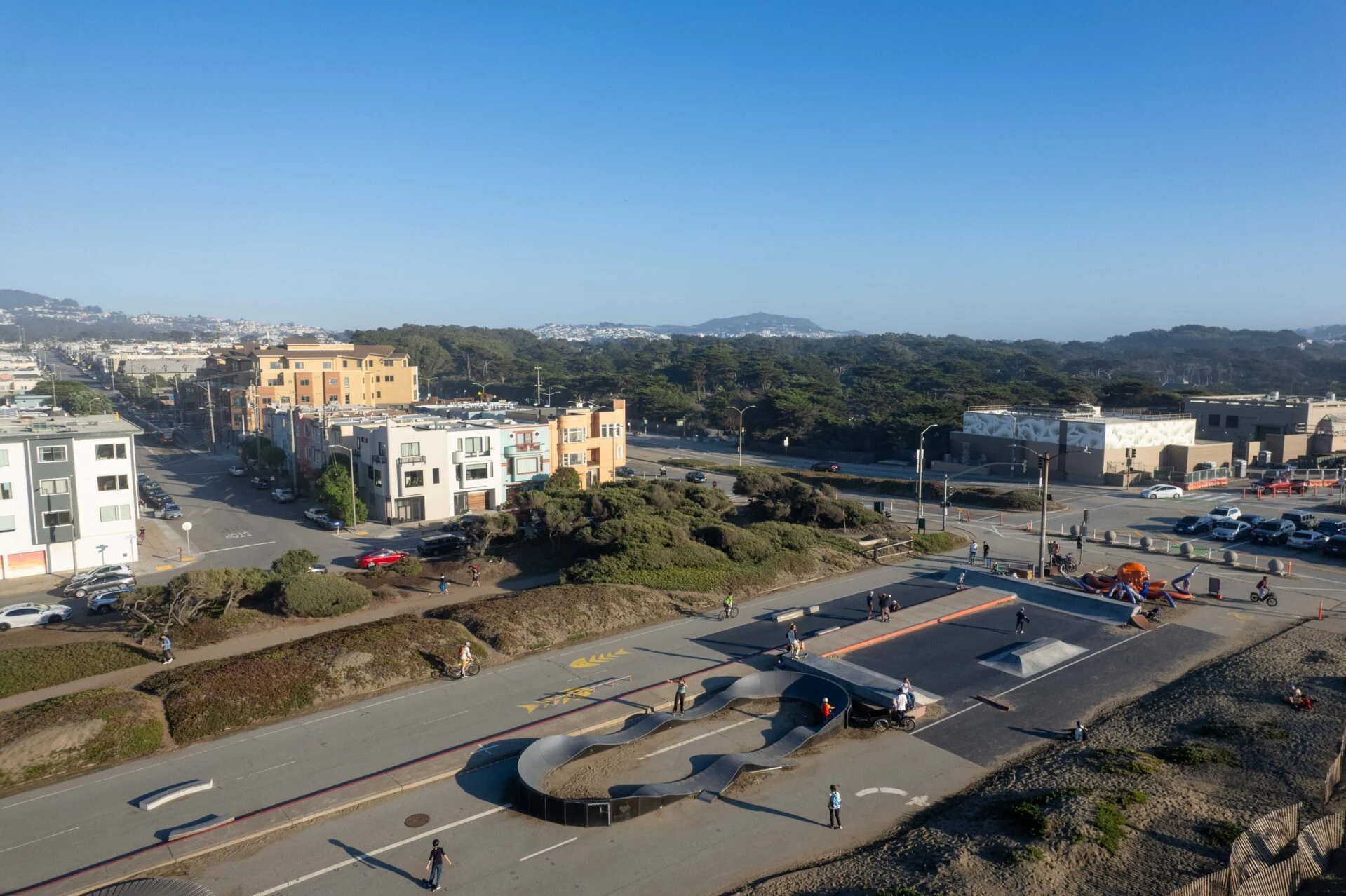 At $2.5 million with a median close of $1.88 million, you have real breathing room here. You are not scraping the ceiling on every offer. The 17% competition tax is moderate by San Francisco standards. Homes are moving but not in the kind of feeding frenzy you see in some of the neighborhoods below.
The typical Parkside home was built between 1925 and 1950, usually with stucco fronts and a floor plan that has bedrooms on separate levels rather than all on one floor. One-car garages are standard, and there is often a bonus room or in-law space below that may or may not be fully permitted. Renovation quality varies widely. A fully gut-renovated three-bedroom, three-bath home on 29th Avenue at 1,837 square feet recently sold for $2.35 million, which works out to $1,279 per square foot.
Parkside is quiet, residential, and car-friendly. You are close to Ocean Beach, Golden Gate Park, and Stern Grove, which hosts free summer concerts. The L Muni line gives you direct access downtown. The 280 freeway is accessible for Peninsula commuters. The honest tradeoffs are fog, limited walkability for daily errands, and the need for a car for most things.
Excelsior tied Parkside with nine sales in this price band, had a lower median of $1.66 million giving buyers real budget cushion, but carries the highest competition tax of any neighborhood in this data set at 26% over asking on 92% of sales.
The math on the competition tax here is important to understand upfront. When you see a home listed at $1.3 million in the Excelsior, you are likely looking at a $1.6 to $1.7 million purchase. That is still well within a $2.5 million budget, but buyers who do not understand the underpricing strategy can feel blindsided.
What you get in return for that competition is significantly more house. A fully renovated three-bedroom, five-bath home on Lisbon Street at 2,835 square feet sold in this analysis. The Parkside home I referenced was 1,834 square feet. That is a thousand more square feet and two more bathrooms for essentially the same budget. The Excelsior home worked out to $785 per square foot versus $1,279 in Parkside.
The housing stock here skews older than Parkside, with true Edwardians and Victorians from 1895 to 1925. That means more character, more quirky additions over the decades, and more variability in how homes have been reimagined. You can find a $1.6 million home that needs everything or a $2.2 million home that is fully done. The neighborhood has a strong community feel, is next to John McLaren Park, the second largest park in San Francisco, and has a good local restaurant scene along Mission Street. The weather is actually quite good, better than Parkside. It does not have the cache of some other neighborhoods, but that is part of why the value is still there.
Bernal Heights had eight sales under $2.5 million with a median just over $2 million and a competition tax around 20% over asking, making it the neighborhood that most closely mirrors the desirability of Noe Valley at a fraction of the price.

I have been watching Bernal Heights for 17 years and it has been in heavy demand for essentially all of that time. It is walkable, sunny, and has 280 access, which is a combination that is hard to find in this price range. When buyers get priced out of Noe Valley, where the entry point for a single-family home is now closer to $4 million, Bernal is often where they land. The fact that you can still get a house there for $2 to $2.5 million is genuinely good.
I toured a Bernal home listed at $1.798 million that sold for $2.4 million, which was 33% over asking. That is above the neighborhood average of 20% and reflects how quickly a well-positioned home can escalate in a neighborhood this desirable. Most of the homes that sold in this analysis closed in the low $2 millions, with only one reaching $2.4 million and another at $2.2 million.
The housing stock is eclectic. Victorians, Edwardians, 1950s homes, and modern builds all exist here in a mix, many of them remodeled in very individual ways. You will find some streets that are beautifully done and some that are very tight with minimal parking. Knowing the block-by-block differences in Bernal matters. The neighborhood has Cortland Avenue for local restaurants and shops, Holly Park, Precita Park, and Bernal Hill, which has some of the best views in the city from a surprisingly accessible trail.
Outer Richmond had six sales with the highest median close price of $2.3 million in this data set, a competition tax of just 16% on 88% of sales, and may be the only neighborhood on this list where prices have not yet surpassed 2021 levels.

At $2.3 million median, this is the tightest fit for a $2.5 million budget. I would not have this be your only neighborhood because you are shopping with very little cushion, but the case for it is compelling.
One comp I pulled here closed in 2021 for $2.45 million. Every broader statistic about San Francisco shows that we are at new highs past 2021, but this particular comp suggests the Outer Richmond may still be on sale relative to where it was four years ago. If that is true, there is real upside here for buyers who get in now.
The neighborhood has a cool, somewhat anti-corporate, artsy vibe that has earned it a genuine following among surfers, creatives, and people who want to live near the water. It was named one of the 40 coolest neighborhoods in the world by Time Out magazine despite, or maybe because of, its low-key reputation. You are right by Land’s End, one of the most beautiful trails in San Francisco, with access through Sea Cliff, Baker Beach, and the Presidio. Golden Gate Park is your backyard. Clement Street has restaurants and daily shopping within the neighborhood itself.
The housing stock here is interesting because there are pockets, particularly west of 25th Avenue, with 1980s and 1990s construction, which by San Francisco standards is practically new. If newer construction matters to you, this is one of the few places in the city where you can find it at this price point.
The commute is the honest tradeoff. You are at the far western edge of the city. Getting downtown takes time. Getting to the South Bay means 19th Avenue, which can be slow. If you work from home or have flexibility on commute times, that matters much less.
Portola had six sales with a median of $1.68 million and a competition tax of 19% over asking, but a 3,100-square-foot home here recently sold for $2.1 million at roughly $680 per square foot, making it the neighborhood where your money goes furthest in this entire analysis.

At a median of $1.68 million, your $2.5 million budget gives you real breathing room in Portola. The competition tax of 19% is in the middle of the range, and notably, roughly one in six Portola sales actually closes at or below list price, which is unusual in this market and represents real opportunity for buyers who are patient and strategic.
The home that stood out in this analysis was a three-story, 3,100-square-foot property that sold for $2.1 million. Three bedrooms and two baths on the upper level, plus an office, then two bedrooms and a family room downstairs, then an additional family room, study, and bedroom on the lowest floor. That is nearly double the square footage of the Parkside home I referenced, 250,000 dollars less, and 69 years newer in construction vintage. The price per square foot worked out to roughly $680, which is one of the most compelling numbers I have seen anywhere in this analysis.
Portola has genuinely good weather, decent proximity to both downtown and the 280, and it is located next to McLaren Park on the south side, which gives you green space and trail access. It does not have a prominent walkable commercial strip, but the neighborhood has been steadily improving and has a strong community feel. If space and value are your priorities and you are willing to be aggressive and patient with offers, Portola is the best value play on this list.
Sunnyside had five sales with a median close of $2.25 million and a competition tax around 20%, but it is the one neighborhood in this entire data set where 100% of sales closed over the list price.

That 100% figure tells you that listing agents in Sunnyside have fully figured out the underpricing strategy. Every single home is priced low to generate competition, and every single one sells above asking. At a $2.5 million budget with a $2.25 million median, you are playing at the very top of your range here. I would want buyers in Sunnyside to ideally have a budget closer to $2.8 or $3 million to compete without constantly bumping into their ceiling.
A three-bedroom, three-bath home at 2,110 square feet sold here for $2.25 million. That works out to $1,066 per square foot. One interesting detail about that particular home: the original structure was 968 square feet built in 1924, and the home has been expanded to more than double its original size. Sunnyside has a lot of these expansion projects, where the original garage or lower level has been built out to add significant square footage. For buyers who want to do that themselves, buying a two-bedroom home and building out the garage space is a real path to getting more house for less money, and in many of the sunset and parkside-adjacent neighborhoods, that work can often be done with an over-the-counter permit.
The weather in Sunnyside is one of its genuine selling points and it often gets overlooked relative to its central location.
Central Sunset had four sales in this price band with a median of $1.75 million and a competition tax of 22%, and it shares most of the same characteristics as Parkside with a similar residential, quiet feel and slightly more budget cushion.

With a median of $1.75 million, a $2.5 million budget gives you real room here. The neighborhood feels very similar to Parkside. A four-bedroom, four-bath home on 27th Avenue sold here for $1.9 million at $975 per square foot. The construction quality is similar to what you see in developer-renovated Parkside homes: not the highest end finishes, but new plumbing, new wiring, and a clean canvas that you can personalize over time.
At $2.5 million, the Marina, Pacific Heights, Cow Hollow, Russian Hill, Noe Valley, Eureka Valley, and Inner Sunset are off the table for single-family homes based on the current data.
I want to say this directly because it will save buyers months of time. If those neighborhoods are non-negotiable for you, the conversation needs to shift to condos and TICs, where you do have options in many of them. That is a completely separate discussion and one worth having, but chasing single-family homes in those neighborhoods at this budget is not a productive strategy in 2026.
The framework I use for buyers at this budget: if sun is your top priority, look at Bernal, Sunnyside, Portola, or Excelsior. If walkability matters most, Bernal and Outer Richmond are your best options. If commute is the priority, the District 10 neighborhoods including Portola, Excelsior, and Mission Terrace offer good 280 access. If space is the main goal, Excelsior and Portola are where your money goes furthest. And if you are willing to be patient and strategic, Portola is the overall value play.
We have done deep-dive videos on almost all of these neighborhoods. If you want to talk through your specific situation, reach out. We have sold 67 homes so far this year, and helping buyers understand where their budget actually works is one of the most important conversations we have.